We Asked AI Shopping Agents to Find 55 Shopify Brands 7,291 Times. 47% Got Impostors.
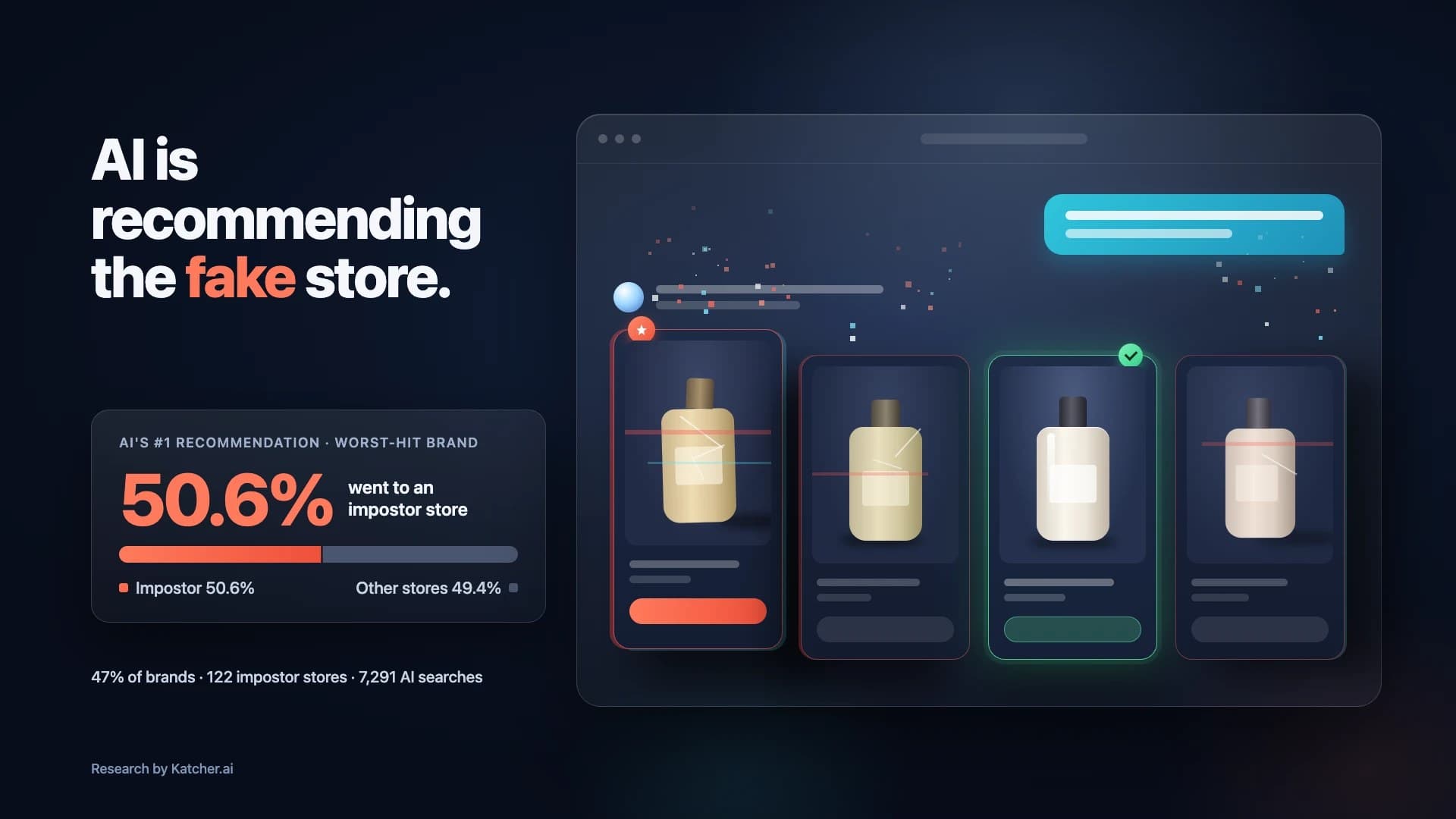
Shoppers have started asking AI instead of Google: "Where can I buy X?" The AI answers with product cards, prices and a buy button, not ten blue links. Shopify's AI shopping catalog is one of the main sources behind those answers. So we asked AI shopping agents to find 55 Shopify brands, 7,291 times, and checked who they actually recommended. Every brand in the run sells through its own Shopify store.
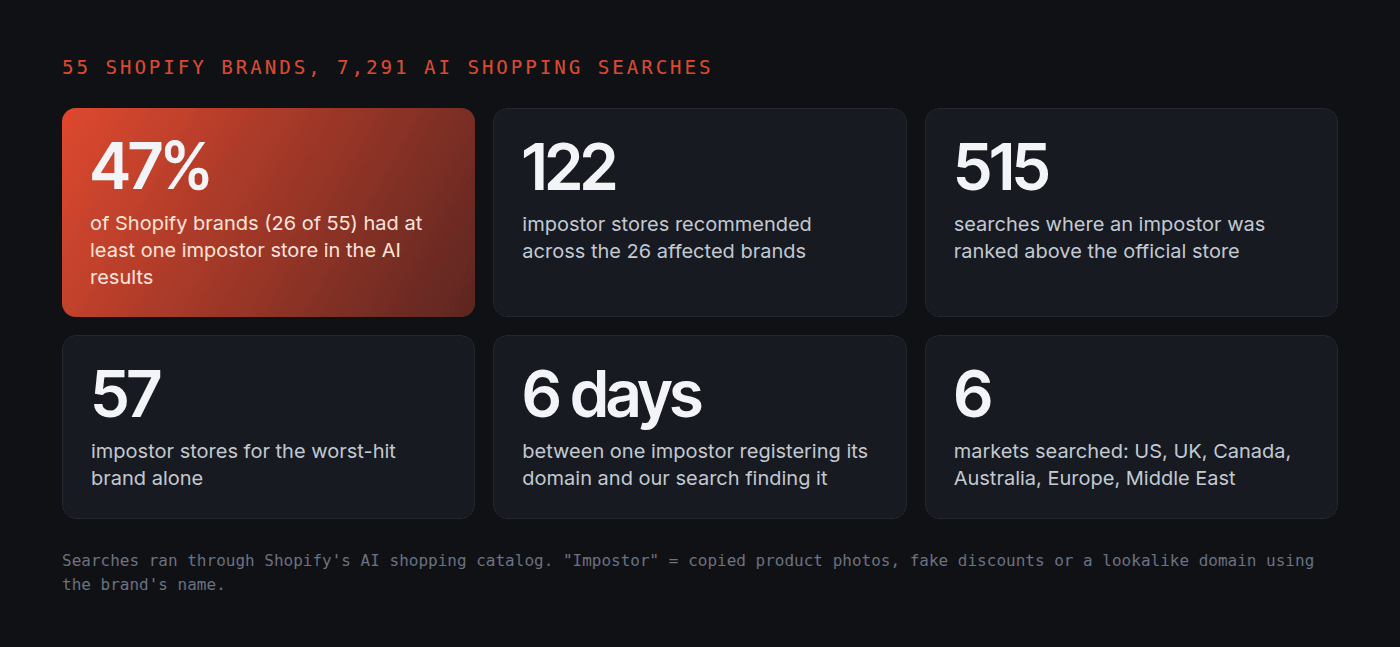
For 26 of the 55 Shopify brands (47%), the AI shopping results also recommended at least one impostor store: copied product photos, fake discounts, or a lookalike domain using the brand's name. We counted 122 impostor stores in total, and in 515 searches an impostor was ranked above the brand's official store.
How we ran it
We ran the searches a shopper would ask an AI shopping agent, through the same Shopify catalog AI assistants draw on:
- The brand's name, on its own.
- Its products, by name and by type.
- Bargain intent: the brand plus "discount", "outlet", "sale" and similar, which is where copies cluster.
Each search ran across six markets: the US, the UK, Canada, Australia, Europe and the Middle East. That came to 7,291 searches for 55 brands. The run was exclusive to Shopify stores: every brand in it sells through its own Shopify store, so the official store in each result is a Shopify store too. For each result we recorded every store the AI recommended and where it ranked against the brand's official store.
A store counted as an impostor when it showed at least one of three things: the brand's own product photos, "discounts" on the brand's products that the brand does not run, or a lookalike domain built from the brand's name.
What we found
The worst-hit brand had 57 copycat stores in the results. One of them had registered its domain six days before we found it, which says something about speed: a copy can be live, listed in the catalog and recommended by an AI agent inside a week.
How bad it gets
Averages hide the shape of this, so here is the spread.
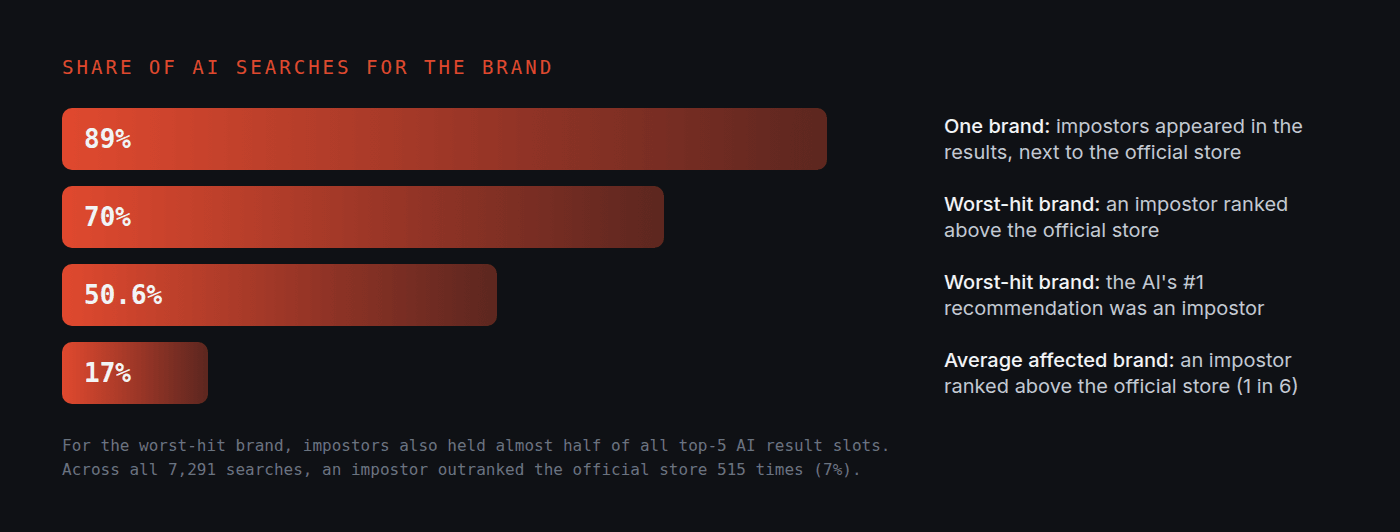
- The average affected brand: in 1 in 6 AI searches, an impostor is ranked above the official store.
- The worst-hit brand: 7 in 10 searches put an impostor above the official store, and in 50.6% of searches the AI's number one recommendation was an impostor. Impostors held almost half of all top-five AI result slots for that brand.
- Another brand: impostors appeared in 89% of AI searches, right next to the real store.
What the AI was recommending
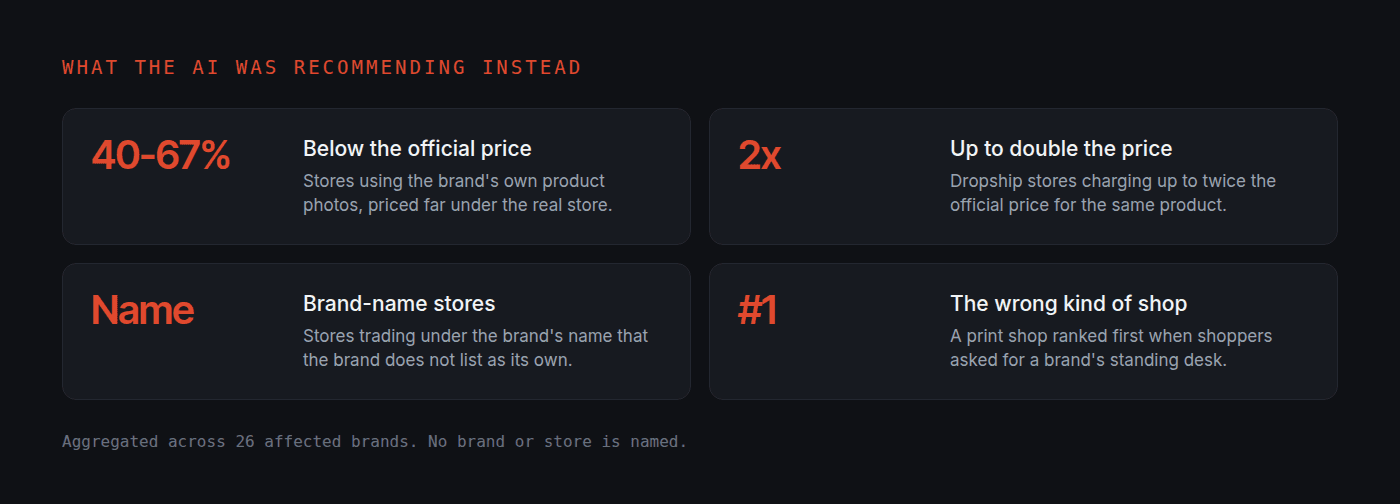
- Stores using the brand's own product photos, priced 40 to 67% below the real store. A price that far under the official one is the signal shoppers fall for and the one brands should look for first.
- "Brand-name" stores trading under the brand's name that the brand does not list as its own.
- Dropship stores charging up to double for the same product. Overpaying is a quieter harm than a fake discount, but the shopper still blames the brand when the parcel takes a month.
- A print shop ranked first for a brand's standing desk. Not every wrong answer is a copy. Some are simply the wrong store, ranked where the official one should be.
Why an AI answer is different from a search result
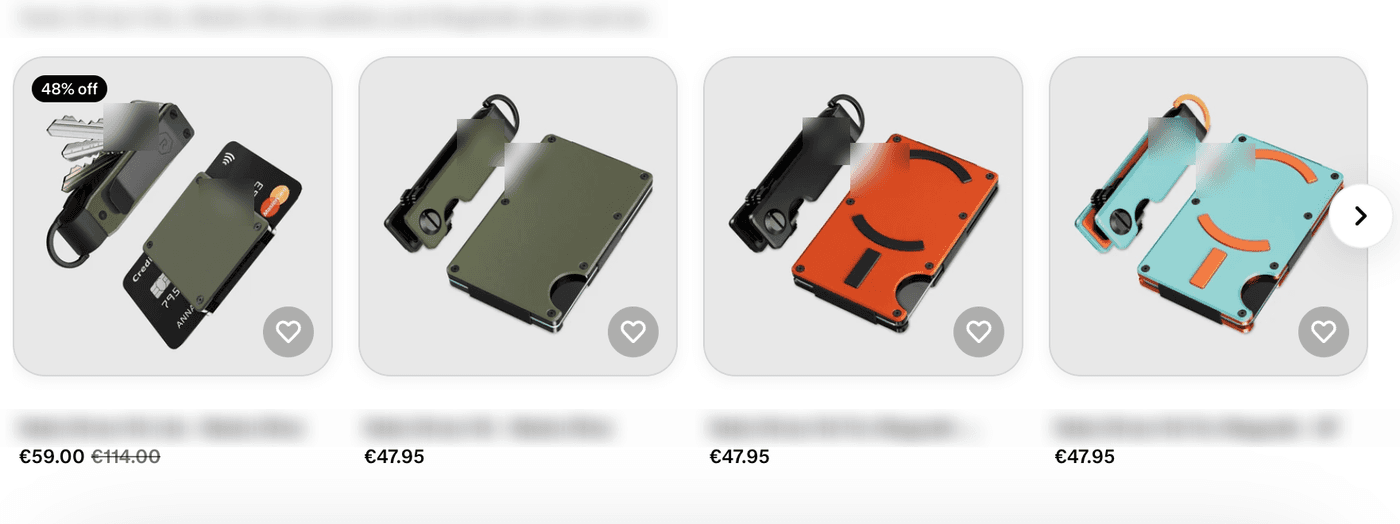
How it looks to a shopper: one AI shopping answer, four product cards, one of them at 48% off. Brand and product names are blurred.
A search page shows ten results and leaves the choice to the shopper. An AI shopping answer makes the choice for them: a short list of product cards, each with a price and a buy button, presented as a recommendation. When the first card is a copy, there is no page of alternatives underneath it to make the shopper hesitate.
All 55 brands run on Shopify, and many of them on Shopify Plus. Most brand monitoring checks Google and the ad platforms, and neither shows what an AI shopping agent recommends, so this is easy to miss. If an AI sends a shopper to an impostor, the brand loses the sale, and the customer usually blames the brand.
What this study does not show
- "Impostor" describes what we observed, not who is authorised. Copied photos, fake discounts and lookalike domains are strong signals, but only a brand knows who it has authorised to sell. Some dropship or reseller stores may turn out to have permission.
- It is a snapshot. Stores appear and disappear within weeks, and AI results change between runs, so a single pass understates how many existed over any longer period.
- 55 brands is not a representative sample of every Shopify brand. It is 55 brands.
- We do not name any brand or store. Naming a brand publishes the fact that it has copies, which is the brand's information to share. We have not contacted the brands.
How to check what AI recommends for your brand
You can run a rough version of this yourself in ten minutes:
- Ask an AI assistant the shopper's questions: "Where can I buy [your brand]?", "[your brand] discount", "[your brand] outlet", and the name of your best-selling product.
- Open every store it recommends. Check the domain, the product photos and the price against your own store.
- Look for the three signals: your own photos, a price far below yours, and a domain built from your name. Domain age is a quick extra check; see how to find fake copies of your website.
- Repeat in each country you sell to, because the results differ by market.
For the ChatGPT side of this, see whether ChatGPT is recommending fake stores instead of your brand. When you find a copy, how to take down a fake website covers the routes in order, and our earlier run, we scanned 25 DTC brands for clones, shows what the same problem looks like on the open web.
Have it checked, and shut down
Katcher does both halves of this. First the scan: Katcher's free imposter scan finds the storefronts using your brand, including the ones AI shopping agents are recommending, and shows you the evidence for each one, so you can see straight away whether a store is one you have authorised.
Then the shutdown, chosen per store. Katcher takes stores down through every route that needs no signature from you: Google Safe Browsing, the host's abuse desk, the registrar, the CDN and the payment processor. We send those reports and chase them. For copyright and trademark notices, which only the rights holder can sign, we prepare the notice with every field filled in, and you review it and send it from your own address.
Katcher is newer than the enterprise brand protection tools and has a smaller takedown track record, and a store taken down can come back on a new domain, which is why the scan keeps running.
About the author
Davis Paipa is the founder of Katcher and of Libautech, and has spent five years building on Shopify. He ran this study on Shopify brands because brands check Google and their ads, and almost nobody checks what the AI tells shoppers.
Questions
Do AI shopping agents recommend fake stores?
Sometimes, yes. In our run of 7,291 AI shopping searches for 55 Shopify brands, 26 brands (47%) had at least one impostor store in the results, meaning a store using the brand's product photos, fake discounts or a lookalike domain. In 515 searches an impostor was ranked above the official store.
Where do AI shopping agents get their product results?
AI shopping answers draw on product catalogs rather than a page of web links. Shopify's AI shopping catalog is one of the main sources behind those answers, which is why our searches ran through it. Any store listed in a catalog like that can appear as a product card with a price and a buy button.
How can I see what AI recommends when someone searches for my brand?
Ask an AI assistant the questions a shopper would ask: where to buy your brand, your brand plus discount or outlet, and your best-selling product by name. Open every store it recommends and compare the domain, the photos and the price with your own store, and repeat it for each country you sell to.
Why does an impostor rank above the official store in AI results?
The study measured what the AI recommended, not why. What we saw is that impostors used the brand's own product photos and names and often priced far below the official store, which makes them look like a strong match for searches with discount or outlet intent.
Which brands were in the study?
We do not publish them. Naming a brand publishes the fact that it has copies, which is the brand's information to share, not ours. The figures here are aggregates across all 55 brands.
Can Katcher shut down an impostor store, or only find it?
Both. The free scan finds the storefronts using your brand and shows the evidence. For shutdowns, Katcher sends and chases every report that needs no signature from you: Google Safe Browsing, the host, the registrar, the CDN and the payment processor. Copyright and trademark notices can only be signed by the rights holder, so Katcher prepares them and you send them from your own address.