Do Shopify Brands Get Copied? 39% of 109 Brands That Ran a Scan Had a Confirmed Clone
- Sample
- 109 brands with a completed Katcher AI scan (not a random sample)
- Period
- Scans from 20 October to 4 November 2026
Brand owners ask us one question before any other: is this actually happening to stores like mine? Here is what our own scans show. Between 20 October and 4 November 2026, 109 brands completed a Katcher AI scan, and a reviewer checked what it found.
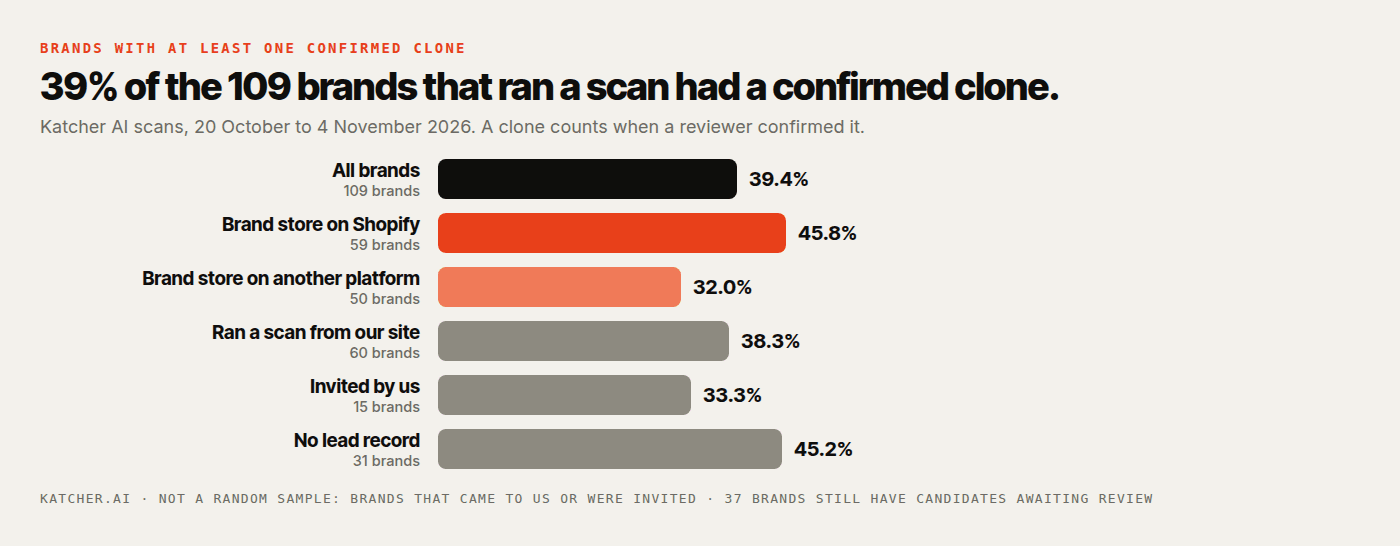
Of 109 brands that ran a Katcher AI scan between 20 October and 4 November 2026, 43 (39%) had at least one copy of their store confirmed by a reviewer, 147 copies in all. Brands whose own store runs on Shopify were affected more often, 46% against 32%. These brands came to us or were invited by us, so the rate describes brands looking at protection, not every brand.
The numbers
Shopify brands were copied more often
Of the 59 brands whose own store runs on Shopify, 27 (45.8%) had at least one confirmed clone, with 2.07 clones per brand on average. Of the 50 brands on other platforms, 16 (32.0%) did, with 0.5 per brand. Of the 147 confirmed clones, 122 (83%) copied a brand whose store runs on Shopify.
Read the gap with one caveat. Half of the non-Shopify brands (25 of 50) still have candidate stores awaiting review, against 12 of the 59 Shopify brands. Every confirmed count here is a lower bound, and the lower bound is lower for the non-Shopify group, so the gap may narrow once those reviews are done.
Most brands had none, a few had many
The median brand had no confirmed clone, and the average was 1.35. That gap between median and average means the copies are concentrated in a minority of brands: the 43 affected brands had 147 confirmed clones between them, 3.4 each on average. For a brand owner, that is the useful part. Being copied is not universal, and a brand that has one copy should look for more.
Whether the brand came to us or we invited it
Brands that come looking for protection may already suspect a problem, which would push the rate up. We split the brands by how they reached us to see whether that shows.
Brands that came to us were not affected at a clearly higher rate than brands we invited, but 15 invited brands is a small group, and neither group is a random draw. We have no random panel of brands to compare against, so no figure here estimates how often brands in general are copied.
What a Shopify brand should do with this
- Check, rather than assume either way. Most brands in this data had no confirmed clone; the ones that did had 3.4 on average.
- Start with the free signals. Search your brand name with "sale", "discount" and "outlet", and look for new domains built from your name; see how to find fake copies of your website and finding lookalike domains.
- Look where shoppers are asking AI. Copies also turn up in AI shopping results; see our study of 7,291 AI shopping searches.
- When you find one, use the routes in order. How to take down a fake website covers them.
Find out whether your store has been copied
Fake clone stores are now built with AI in minutes, and Katcher AI closes them with AI. Its scan checks lookalike domains, your product photos, Meta ads and AI shopping results, and shows the evidence for every store it finds, so you can see straight away whether a store is one you have authorised.
Its AI agent sends and chases the reports that need no signature: Google Safe Browsing, the host, the registrar, the CDN and the payment processor. For copyright and trademark notices you choose: our AI agent submits it in your name under a letter of authorization you sign, you send it from Claude through the Katcher AI connector, or you send it yourself. Plans start at $99 a month, all with unlimited takedowns.
Research transparency
Sample
Every brand that ran a Katcher AI self-serve scan with a completed domain scan between 20 October and 4 November 2026: 109 brands, one account per brand, with test accounts excluded. 60 ran a scan from our website, 15 were invited by us, 3 signed up directly and 31 have no lead record. Every brand either came to us or was picked by us. There is no random panel, so the rates describe brands that looked for protection or were offered it, not all Shopify brands.
Definitions
- Confirmed clone: a candidate storefront that a Katcher AI reviewer marked as a finding. Candidates reviewed as unrelated, parked, for sale, not resolving or the brand's own are not counted.
- Brand store on Shopify: the brand's own storefront showed Shopify markers when checked on 5 November 2026.
- How the brand reached us: from the lead record in our funnel. Some brands who ran a scan from our site arrived through an invitation email, so "ran a scan from our site" is not purely inbound.
What this cannot establish
- How often brands in general are copied. Without a random panel, there is no way to correct for who chose to scan.
- Size or category. We do not record revenue or vertical for scanned brands, so there is no split by either, and no revenue level at which copying starts.
- Authorisation. Only a brand knows who it has authorised to sell. Each figure is an observation, not a conclusion about any party.
- Final counts. 37 brands still have candidates awaiting review, so every confirmed figure is a lower bound.
Checking the figures
Each share is a ratio of published counts: 43 of 109 brands is 39.4%, 27 of 59 is 45.8% and 16 of 50 is 32.0%. The per-group figures are in the aggregate data file (CSV). We do not name any brand or store, because naming a brand publishes the fact that it has copies, which is the brand's information to share.
Related research
- Do AI shopping agents recommend impostor stores? 7,291 searches for 55 Shopify brands.
- We scanned 25 DTC brands for clones: lookalike domains and certificate logs, September 2026.
- How to take down a fake website
- Katcher AI pricing
About the author
Davis Paipa is the founder of Katcher AI and of Libautech, and has spent ten years on Shopify, first as a store owner and then building Shopify apps.
Questions
Do Shopify brands get copied?
Often, among the brands we see. Of 59 brands whose store runs on Shopify that ran a Katcher AI scan between 20 October and 4 November 2026, 27 (45.8%) had at least one copy confirmed by a reviewer, against 32.0% of brands on other platforms. These brands came to us or were invited, so the rate is not an estimate for every brand.
How many fake copies does a brand usually have?
The median brand in our data had none, and the average was 1.35 confirmed copies per brand, 2.07 for brands on Shopify. Copies are concentrated: the 43 affected brands had 147 confirmed clones between them, 3.4 each on average.
Are brands that come looking for protection more likely to be copied?
Not clearly, in this data. 38.3% of brands that ran a scan from our site had a confirmed clone, against 33.3% of the 15 brands we invited. The invited group is small, and neither group is a random sample.
Does the size of a brand affect whether it gets copied?
We cannot say from this data. Katcher AI does not record revenue or category for scanned brands, so there is no split by size or vertical.
How can I check whether my store has been copied?
Run a free scan at katcher.ai. It checks lookalike domains, your product photos, Meta ads and AI shopping results, and shows the evidence for each store so you can see whether it is one you have authorised.