65% of Health & Wellness Brands We Checked Had a Store Pretending to Be Them
- Sample
- Health and wellness Shopify brands checked by Katcher AI (percentages only)
- Period
- Late October to early November 2026
Supplement, nutrition, functional drink and wellness device brands sell products people swallow or use on their bodies, and their shoppers compare prices closely. That makes them easy to copy and easy to undercut with a fake "deal". We went through what Katcher's checks found for health and wellness Shopify brands between late October and early November 2026.
65% of the health and wellness brands we checked had at least one store pretending to be them. The median fake store claims 70% off, 84% of the fake stores are still online, and 53% of them run on Shopify, more than twice the rate across all the categories we check (21%).
The numbers
Every figure below comes from Katcher checks of health and wellness brands (supplements, nutrition, functional drinks and wellness devices) run between late October and early November 2026. We publish percentages only and name no brand or store. A store counted as fake when it presented itself as the brand: its logo, its product photos and text, or a web address built from its name.
In this category, the copy is usually on Shopify
Across all the categories we check, 21% of fake stores run on Shopify. For health and wellness brands the figure is 53%. A Shopify template gets a store that looks like a supplement brand online in an afternoon, and when the copy runs on the same platform as the real store, the checkout and page layout a shopper sees look familiar on both.
Bigger brands draw lookalike domains
Among 8-figure health brands, 76% had lookalike web addresses sitting on hosting tied to known scam networks. A lookalike address is your brand name with a small change: an added word like "shop" or "official", a swapped letter, or a different ending such as .shop or .store. Our guide to finding lookalike domains shows how to search for them by hand.
AI shopping results show the copies too
83% of the brands had other stores in Shopify's AI shopping catalog that use their product photos or sell their products for 40% or more below the brand's own price. That catalog feeds the product cards AI assistants show when a shopper asks where to buy something, so a copy listed there can appear next to the real brand, or in its place.
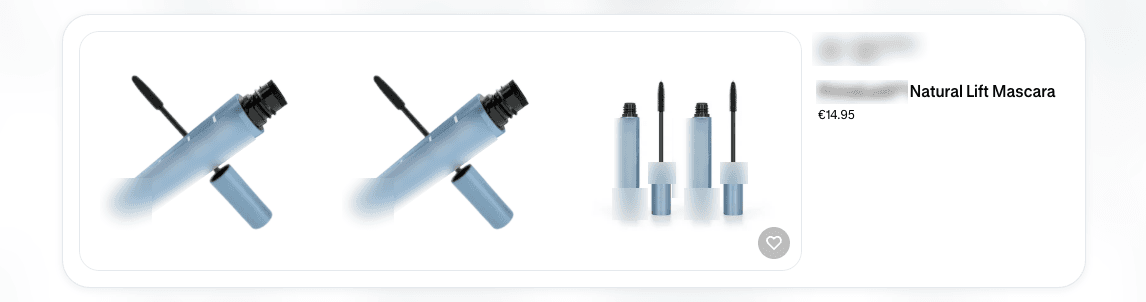
This is what that looks like to a shopper. An AI shopping assistant recommended this product card: the brand's own product photos and product name, at €14.95, sold by a store that is not the brand. We blurred the brand name, the store name and the logos. Some of these stores may be resellers you have authorised, and only you can tell which. The evidence for each store is what lets you decide. Our earlier study covers how often AI shopping agents recommend impostor stores across categories.
Five cases, with names removed
- A herbal wellness brand. One fake store sells the brand's best-seller with the brand's own product photo, at a far lower price. Separate clones on .shop addresses copy the logo and the products and claim 70% off.
- A functional drinks brand. A fake store copies the logo and products, claims 70% off and takes orders. Another copy runs in many languages and claims about 50% off.
- A sports nutrition supplement brand. Fake stores copy its logo, product text and photos. One of them lists fake contact details.
- A home health device brand. Template shops on Shopify copy its products and photos.
- A supplement brand. A lookalike store copies its logo and products and pushes an extra discount for paying in crypto.
The real store next to the copies
Here is one herbal supplement brand from the checks, with the brand name, product names, logos and store names blurred. In each pair, the brand's own product page is on the left and a store copying it is on the right.
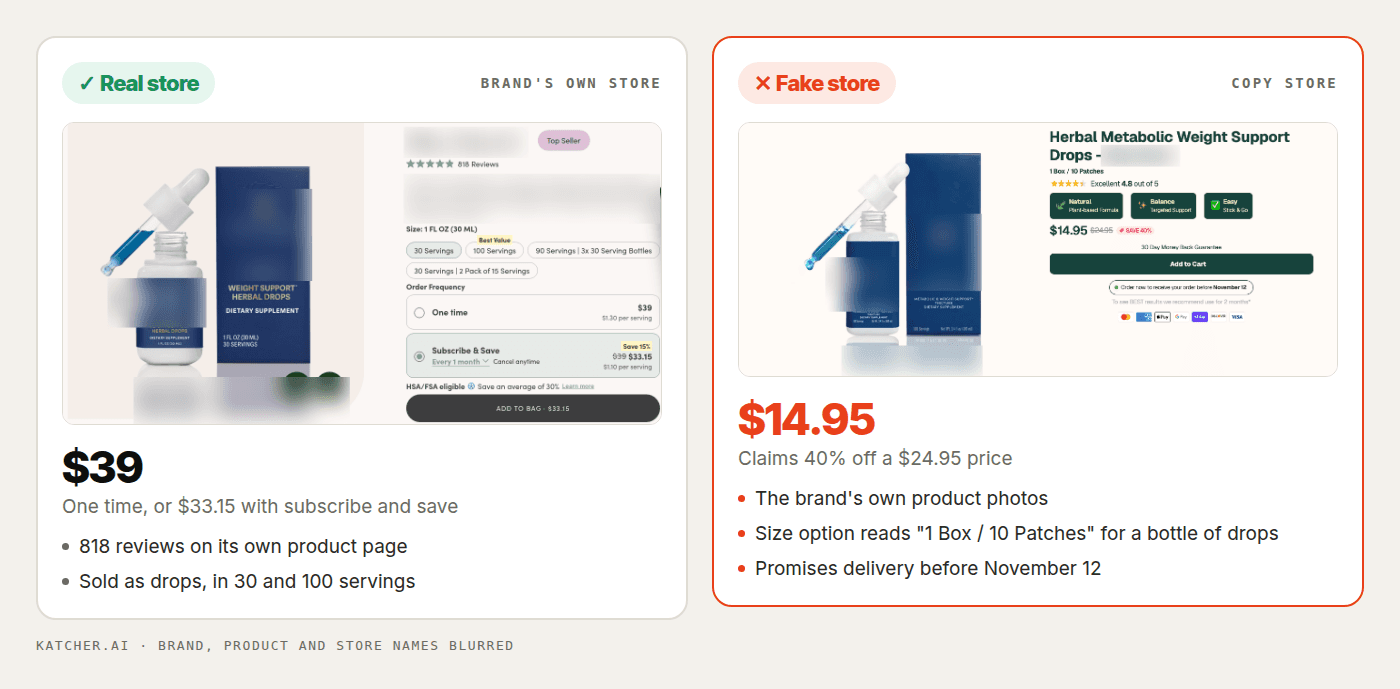
The first copy uses the brand's product photos and sells the drops for $14.95, claiming 40% off. On the brand's own store the same bottle is $39. The copy's size option reads "1 Box / 10 Patches", for a product that is a bottle of drops.
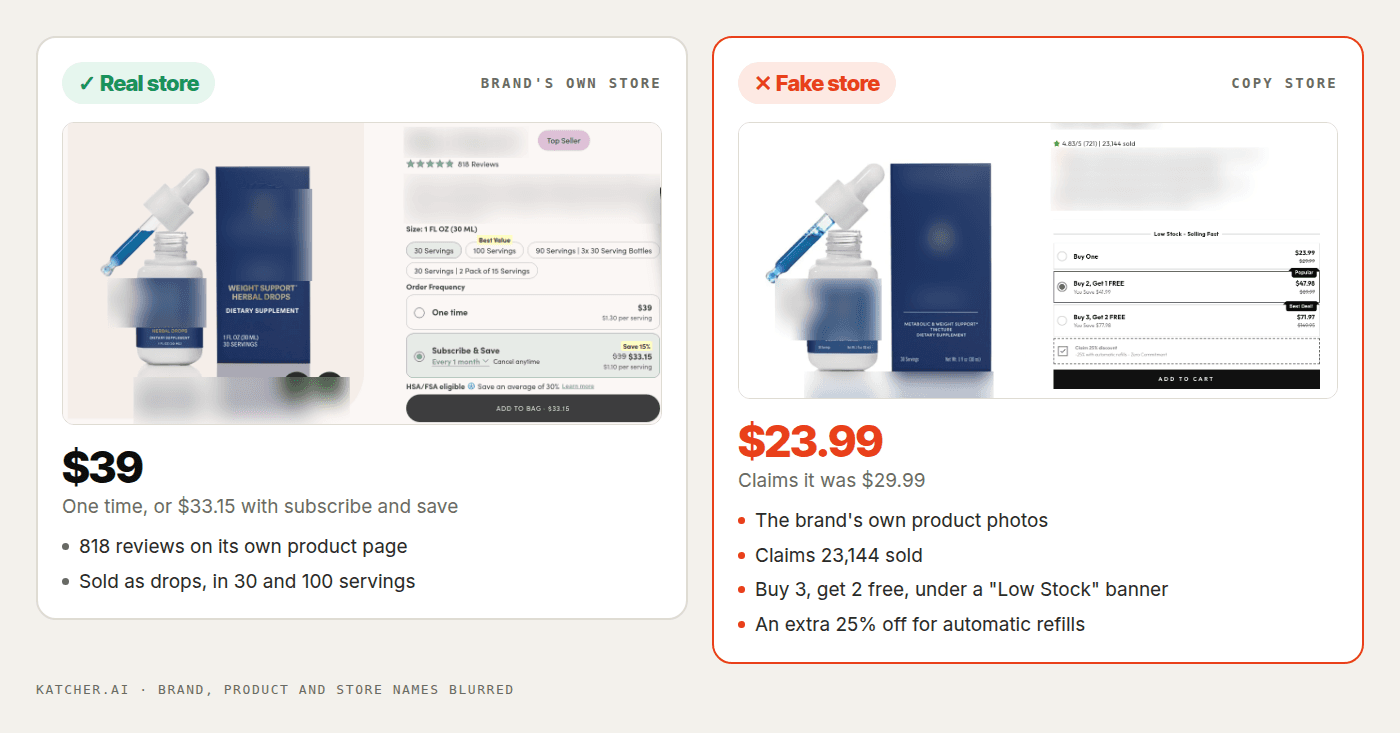
The second copy uses the same photos at $23.99. It claims 23,144 sold and stacks offers on top: buy 3 get 2 free, a "Low Stock" banner and an extra 25% off for automatic refills.
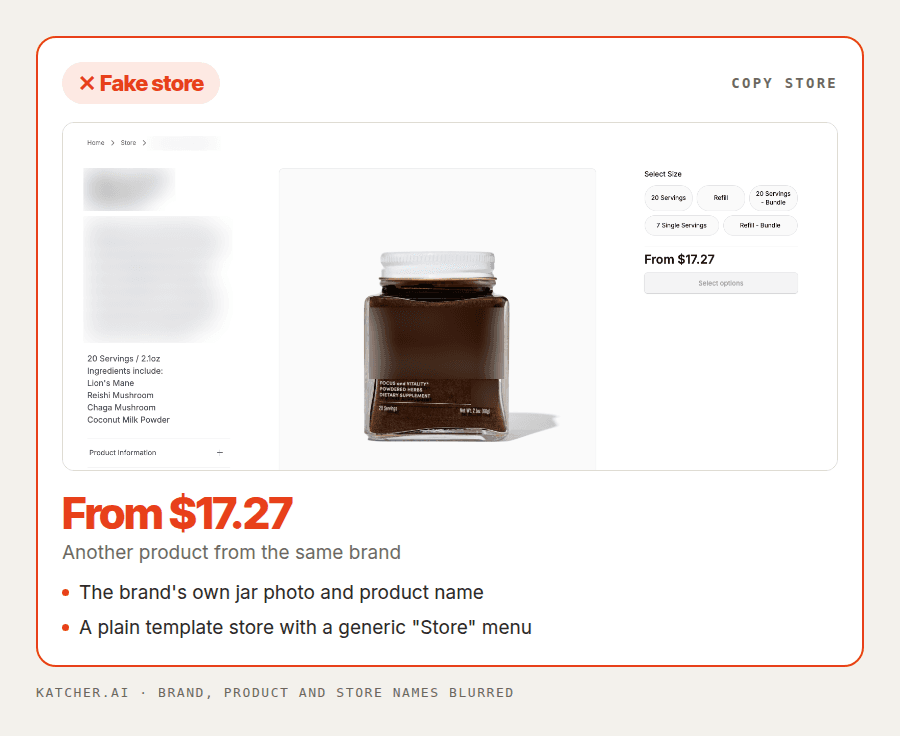
A third store sells another of the brand's products, using its jar photo and product name, from $17.27.
The cost lands on the real brand
- People swallow or use these products. A fake store may ship counterfeit product, or nothing at all.
- The complaints come to you. The bad reviews, the angry emails and the chargeback disputes tend to land on the real brand, not on a store that has already moved to a new domain.
- A 70% discount on supplements looks believable. Shoppers are used to bundles, subscriptions and frequent promotions in this category, so a large claimed discount does not stand out.
- AI assistants can pick the copy. An AI shopping assistant can surface the fake listing instead of the real brand.
Black Friday is when a fake 70% off looks most like a real deal
Black Friday falls on 27 November 2026, with Cyber Monday on 30 November. That week your customers go looking for the cheapest price on products they already buy, and more of them ask an AI assistant to find it. A store claiming 70% off your best-seller looks like one more Black Friday offer, and it can sit in the same AI results as your real one. Shoppers hunting for the lowest price are the ones most likely to pick it.
If you want copies found before the sale starts, check now. 84% of the fake stores we found are still online, and takedown reports take days to work through hosts, registrars and payment processors.
How Katcher checks your brand
Katcher looks for stores pretending to be your brand, including:
- lookalike web addresses built from your brand name
- stores using your logo
- copies of your product photos, product text and products
- fake listings in AI shopping results
For each store it shows the evidence, so you can see straight away whether it is one you have authorised. Then it helps take them down. The reports that need no signature from you, to the host, the registrar and the payment processor, our AI agent sends and chases. For copyright and trademark notices you choose: our AI agent submits the notice in your name under a letter of authorization you sign, you send it from Claude through the Katcher AI connector, or you send it yourself. A store taken down can come back on a new domain, which is why the checks keep running.
What this data does not show
- These are the health and wellness brands Katcher checked in that period, not a random sample of every brand in the category.
- Discounts are what the stores claim on their own pages.
- Whether a particular store is authorised is something only the brand can confirm.
- Stores go up and come down within weeks, so this is a snapshot of late October and early November 2026.
Check if your store has impostors
Enter your store's domain below. The check is free, and the results come with the evidence for every store found.
About the author
Davis Paipa is the founder of Katcher AI and of Libautech, and has spent ten years on Shopify, first as a store owner and then building Shopify apps.
Questions
How common are fake stores for health and wellness brands?
In Katcher checks of health and wellness brands in late October and early November 2026, 65% had at least one store pretending to be them, using the brand's logo, product photos and text, or a web address built from its name. 84% of those fake stores were still online.
How big a discount do fake supplement stores claim?
The median fake store in our health and wellness checks claims 70% off. Some copies claim around 50% off, and one pushed an extra discount for paying in crypto. These are the discounts the stores claim on their own pages.
Are fake health and wellness stores built on Shopify?
Often. 53% of the fake stores we found for health and wellness brands run on Shopify, more than twice the rate across all the categories we check (21%).
Do fake stores target Black Friday shoppers?
Black Friday (27 November 2026) and Cyber Monday (30 November) are when shoppers look hardest for the cheapest price, often through AI assistants. A fake store claiming 70% off looks like another Black Friday deal that week. In our health and wellness checks, the median fake store claims 70% off and 84% are still online, so it is worth checking your brand before the sale.
How can I check whether my brand has a fake store?
Run a free check at katcher.ai. It looks for lookalike web addresses, stores using your logo or product photos, and fake listings in AI shopping results, and shows the evidence for each store so you can see whether it is one you have authorised.